


THE PROBLEM
You already know your dog is carrying something. You've known for a while.
Maybe you've read Foundations and the body language has finally clicked into place. Maybe we've worked together and you want to go deeper on your own. Or maybe you've simply spent years with a quiet sense that there was more going on with your dog than anyone could quite explain to you.
Whichever it is, you've probably arrived at the same wall.
You can see the signals now. You still don't know what's sitting underneath them — or what to actually do about it. And that gap is a frustrating place to stand.
This is the guide that closes it.

WHAT THIS IS
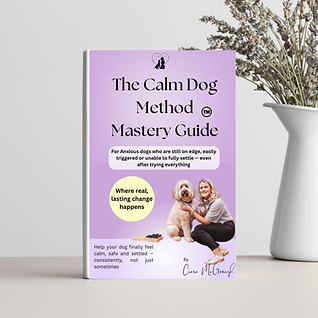
Mastery is the complete Calm Dog Method™, written down properly in easy to follow steps.
It's the same framework I work with in my 1:1 sessions: how I find where stress is held, how I read what's driving it, and how I decide what a dog needs in order to release it. Laid out so you can work through it with your own dog, at your own pace, in your own front room.
It isn't a longer version of Foundations.
Foundations teaches you to create the conditions for calm. Mastery teaches you to release what's blocking it.
WHAT'S INSIDE
Why your dog still isn't fully settling How to identify the specific layer that's keeping them stuck, when you've already done everything Foundations asks of you and something still hasn't shifted.
The full nine-chakra system for dogs
Including the Brachial Chakra, which most trainers have never heard of. Where dogs hold different kinds of stress, what each pattern looks like in behaviour, and how to work gently with it rather than against it.
The Emotion Balance Technique™, in full My own trademarked process for releasing the emotions your dog has been mirroring back to you. Broken into steps you can genuinely follow — what I'm doing at each stage, why it matters, and how to work through it with your own dog.
Animal communication, from the beginning How to actually hear what your dog has been trying to tell you. How to open the channel, how to tell genuine intuition from your own hopeful projection, and how to build real trust in what you're receiving. It's the section people are most unsure about beforehand, and the one they tell me changed the most.
A complete daily, weekly and monthly rhythm So calm becomes your dog's baseline rather than their occasional state. This is the part that makes everything hold.
.png)
Foundations — $27 Mastery — $97 Your Blueprint — $197
Create the conditions for calm
Yes
Yes
Yes
Release what's blocking it
-
Yes
Yes
The nine-chakra system
-
Yes
Yes
The EBT method itself
-
Yes
Yes
Animal communication
-
Yes
Yes
Done with you, by me
-
-
Yes
A written plan for your dog
-
You create it
I create it
Mastery is for you if you'd like to learn the method yourself. The Blueprint is for you if you'd rather I did it with you. And plenty of people happily do both.
WHO IT'S FOR
-
Anyone who's read Foundations and wants to go all the way in
-
Anyone living with a dog whose anxiety has been going on a long time
-
Anyone drawn to the energetic side of this who'd love a real structure rather than vague intuition
-
Practitioners — trainers, groomers, walkers, therapists — who want this lens for their own work
AND WHO IT'S PROBABLY NOT FOR
-
Anyone after behavioural exercises or obedience work. That's genuinely not what this is.
-
Anyone who'd rather it was done for them — book a Blueprint instead, you'll get far more from it.
-
Anyone not quite ready to look at their own nervous system. Half of this method is you, and I'd be doing you a disservice to pretend otherwise.
MY PROMISE TO YOU
Work through the first two sections with your dog. If you don't understand them more clearly than you did when you started, email me within 30 days and I'll refund you in full. Keep the guide — I'd like you to have it either way.


WHO I AM
Hi, I'm Ciara, founder of The Calm Dog Method™.
Years spent reading dogs — formally, through an Advanced Diploma in Animal Science and Behaviour, and practically, in the company of a great many of them — taught me that the ones who don't respond to the usual approaches aren't broken and aren't difficult. They're holding something that behavioural work was never really built to reach.
So I went looking for tools that could reach it. I trained as a Reiki Master with intuitive training, and in animal communication. The Emotion Balance Technique™ grew out of putting all of that together, and I've been working with it alongside clients since 2021 — this guide is the whole of it, written down for you.
There's nothing I use in my 1:1 work that isn't in these pages.
PRICING
The Mastery Guide — $97 AUD
Instant download. Lifetime access, and every future update included.
Read Foundations already? Your $20 code works here.
SCOPE OF PRACTICE
This work supports your dog's emotional wellbeing and sits alongside veterinary care rather than replacing it. Nothing in this guide diagnoses or treats medical conditions. Changes in behaviour can have physical causes — so if something doesn't shift, or if it worsens, please do see your vet.
FAQ
Do I need Foundations first? Foundations is genuinely the better starting point and Mastery assumes you've implemented Foundations methods first.
Do I need any experience with energy work? None whatsoever. The EBT sections assume you've never done anything like this in your life.
Will it work with a dog I don't live with? It will. The method isn't tied to location — it's the same principle that lets me work with clients' dogs over Zoom from the other side of the world.
Can I use this professionally? In your own practice with your own clients' animals, absolutely. The Emotion Balance Technique™ is trademarked, so it isn't something you can teach or sell as a method — but do get in touch if that's the direction you're heading, I'd love to talk.
What if I get stuck? Book a Blueprint session. Sometimes it's far easier to watch it happen once with your own dog than to read about it.